Showing posts with label History. Show all posts

Sunday, 12 July 2020

Gallipoli - The Russo-Turkish War


In April 1876 a revolt had broke out in Bulgaria. A minor, if bloody affair, the matter would escalate over the next two years, dragging in one by one four of the Great Powers of Europe until the world was on the brink of a global war.

This was to be the last time the Great Powers would fight before the First World War. The conflict created the borders of southwestern Europe that we know today, and saw the first use of the Red crescent flag. 

In the grander scheme of things, the Bulgarian revolt was part of the long decline of the Ottoman Empire. In 1683 it had been on the verge of capturing Vienna, but now had only a toe hold in Europe. But even as the Ottoman Empire declined, its great enemy, the Austrian Empire, had also waned. The balance of power in Europe was shifting. France had been humbled by defeat in the Franco-Prussian War of 1870, and so the mightiest powers in Europe were Germany, with it's great industry, Russian, with its rapidly expanding empire in Central Asia, and, of course, Britain, whose industry and empire were both the envy of the world. 

It was in the interests of Russia that the Ottoman's be driven from the Balkans, so the slavs of its Christian provinces could join the Russian Empire, and it was in the interests of Britain that they stay, so that Russia could not gain a Mediterranean port from which she could threaten the flow of trade through the Suez Canal to Britain. It was in the interests of Germany that there should be peace.  


In 1854 France and Britain had come to Turkey's aid when Russia had attacked. This time France was not a player and public opinion in Britain, outraged by the behaviour of Turkish irregulars was not on the side of the Ottomans. 

Russian first bought off Austria-Hungary by offering them the Ottoman province of Bosnia-Herzegovia, then used her ally Serbia to attempt to capture Bulgaria. When this failed, she declared war herself. 

The forces were actually fairly even. 300,000 Russians faced 200,000 Turks, who had the advantage of interior lines of communication, control of the sea, and fortified positions. In terms of abilities the two sides were very different. Russians who were strategically aggressive but tactically inept. The Ottomans were strategically passive but tactically brilliant. 

This was shown by the fate of Osman Pasha, and his army of 30,000 men. Outmanoevred and surrounded, he then fought off a succession of Russian attacks in a siege that would make him famous and preserve Ottoman Europe for another forty years. 


After the third failed attack on Osman's position in the unremarkable town of Plevna, when Csar Nicholas II and invited dignitaries from across Europe watched 100,000 Russian soldiers fail to defeat a force less than a third of their size, the Russians called in General Todleben, the hero of Sevastopol. He encircled the town with siege works and when the starving Turks attempted to break out they were repulsed in fierce hand-to-hand fighting. The next day Osman Pasha surrendered.

It was now December 1877. Constantinople was held by no more than 20,000 Turkish troops. By the end of January 1878 the Russian army had reached the village of San Stefano, nine miles west of Constantinople. Fearing that the great city would fall, British Prime Minister Disraeli sent the Royal Navy's Mediterranean Fleet through the Dardanelles to defend it. At the same time 200,000 Austro-Hungarian troops were massing on the border of Bosnia and Herzegovina.

The stage was now set for a confrontation between the Great Powers. 

Saturday, 27 June 2020

The Admiralty's orders to Admiral Hornby


Admiralty, London, 6.40 p.m., Jan. 23, to Admiral, Vourla, 11.55 A.M., Jan. 24. " Secret. " 

Sail immediately for Dardanelles and proceed with the fleet now with you to Constantinople. Abstain from taking any part in contest between Russia and Turkey, but waterway of Straits is to be kept open, and in the event of tumult at Constantinople, protect life and property of British subjects. Use your judgment in detaching such vessels as may be necessary to preserve waterway of Dardanelles, but do not go above Constantinople. Report departure, and communicate with Besika for possible further orders, but do not wait if none are there. Keep your destination absolutely secret.

Afghanistan - The British Indian Army

The Indian Army that marched through the Khyber Pass towards Kabul really needs very little introduction. Some of its regiments; the Gurkhas, the Guides and the Bengal Lancers, were amongst the most famous in the world, and its exploits would be the subject of Boy's Own tales of daring-do for most of the next century. But what actually was the Indian Army?

The Indian Army was one of the greatest benefits of the Britain gained from its empire. As a naval power, she had only ever maintained a small standing army. However, possession of India gave Britain the use of the only modern, professional fighting force outside of Europe and North America. What's more, the Indian Army was paid for entirely by the India taxpayers. Even the 65,000 soldiers of the British Army stationed in India were paid for by the Indians. 

As well as excursions in the Afghanistan and Burma, the Indian Army would find itself deployed as far afield as Egypt, Sudan, China and Abyssinia. From the Suez Canal to Hong Kong, the Indian army was the premier military power over nearly half the surface of the globe. 

The Indian Army's officers were thoroughly professional. The British Army may have abolished the purchase of commissions in 1871, but this didn't stop the officer corps being dominated by those with inherited wealth. As it was essentially impossible to live on an officers pay at home, the talented, but impoverished, officers made their way to the Indian Army. There they commanded Sikhs, Muslims and Hindus who were long-service volunteers who took their soldiering seriously. 

Since 1842, the frontiers of the British Empire had pushed forwards to the Afghan border. The job of pacifying the fiercely independent tribes of the Northwest Frontier had given the Indian Army plenty of experience in mountain warfare. They had learnt the hard way the importance of crowning the heights and covering a withdrawal. So, the Indian army marched into Afghanistan confident in its officers, its men and its tactics. However, there were problems.

Firstly, in 1878, the Indian Army didn't really exist. There was a Commander-in-Chief, accountable to the Viceroy, and in 1878 this was general Sir Frederick Haines, a veteran of the Crimean War. However, the native regiments all remained, with the exception of the small Punjab Frontier Force, under the control of the three 'presidencies' of Bengal, Madras and Bombay. There was no single 'Indian Army' at all. The disorganisation didn't stop there though. The Military Department, responsible for the supply of men, munitions and stores, was accountable directly to the Viceroy, and not under the control of the commander-in-chief. Important decisions could be kicked about between the CinC, the Military Department and the three presidencies endlessly. 

The job of supplying the army meanwhile had essentially been privatised. Quartermasters went on campaign with a chest of money, but nothing else. The actual supplies were bought from private venders who followed the army in a huge caravan. Camp followers in Indian armies usually outnumbered the actual soldiers by four to one. The system was barley adequate at the best of times, and when the supply lines extended over a hundred miles across treacherous mountain passes, where the locals thought nothing of helping themselves as the convoys went past, almost collapsed. Medical facilities were also inadequate, and there was no Intelligence Department at all, . 

As well as not being unified, the Indian army wasn't concentrated either. Peshawar, Rawalpindi, Lahore, Secunderabad, Lucknow, Bangalore and Calcutta had large barracks, but most of the army was scattered across the sub-continent in one and two regiment stations. These small stations were essentially a garrison keeping a potentially rebellious population in check. There was also a serious lack of organisation above the level of the regiment. What's more, even if there had been an organisation for these disparate regiments to be fitted in to, there was often no transport to carry them forwards, and, even more crucially, no alternative police force to fill the void if they did.

What's more, the fear of future mutinies meant that as the firepower revolution transformed the weaponry of the British Army, the Indian Army was always one step behind. When the British regiments received their fist breech loading rifles, the Indians held on to their old muzzle loaders. When the Martini-Henry came along it was issued to the British battalions, whilst the Indian regiments received the old Sniders. Against tribal opponents with jezails this made very little difference, but if asked to fight Russians with their new Berdan rifles, the Indian Army was likely to find itself outgunned. 

Another safety measure against a second mutiny was that, apart from the mountain guns of the Punjab Frontier Force, all the artillery was in British hands. With fifteen horse and 43 field batteries there was a reasonable number of cannons. However, the majority were 9 pounder muzzle loaders. This was a relatively light gun, by European standards, in 1878. The standard British field gun at the time was the 13 pounder. Also, by this time, the rets of Europe used breech loaders, leaving the British as the odd ones out still loading their guns at the front. Before recoil mechanisms came along breech loaders didn't enjoy a significant advantage in terms of rate of fire, but guns that loaded at the back usually had more range. 

The officers of the army were indeed exceptional, but there were also very few of them. The usual staff was seven, of which one was usually on furlough in Britain. A bloody battle or a sickly season could decimate the officers of a regiment. Each presidency had a pool of officers that were sent out to the regiments as needed. Alas, as there was no general staff, when brigades and divisions had to be formed in time of war, their staff had to be taken from the regiments, further depleting the number of officers. The lack of higher formations meant that whilst officers were promoted by time served, there was usually no more senior positions for them to move up to. As a result majors could be found commanding companies and lieutenant-colonels commanding wings.

The best officers would want to see action, and this meant service in the Northwest Frontier with the Bengal Army. Nobody wanted garrison duty in a remote and inhospitable station. So, whilst the leadership of the regiments most likely to see combat was excellent, those of the units that would make up the reserve was often questionable.

Indians could never become officers, and the highest one could rise was Subedar-Major, the equivalent of a Sergeant Major in the British Army. As promotion was also by seniority thy could also be elderly by the time they did so. Sita Ram, the only sepoy to have written a book about his experiences, eventually became a Subedar, but only after 48 years of service and at the age of 62. 

Which brings us on to the raw material of the army, the soldiers. The European regiments of the East India Company became part of the British Army when it ceased to exist. Indeed, in 1878, one, the former Bengal European Regiment, would be in Malta waiting to go into action under its new name of the 101st Regiment of Foot. The army consisted of Indians, but did not include every type of Indian. The British had a bizarre concept of 'martial races' from which they recruited. Generally, these were lighter skinned northern Indians. This limited the available manpower of the army. Also, as recruitment was the responsibility of the individual regiment, there was no way to replenish losses whilst on campaign.  

The Indian Army then was a more than adequate force for colonial policing. But, whilst it had the potential to become an army that could take on the best in the world as an equal, and in the twentieth century would do so. But in 1878 it had a number of weaknesses that would be found out in a prolonged conflict.

Tuesday, 16 June 2020

William Morris on the Eastern Question

To the Working-Men of England

Friends and fellow-citizens

There is danger of war; bestir yourselves to face that danger: if you go to sleep, saying we do not understand it, and the danger is far off, you may wake and find the evil fallen upon you, for even now it is at the door. Take heed in time and consider it well, for a hard matter it will be for most of us to bear war-taxes, war-prices, war-losses of wealth and work and friends and kindred: we shall pay heavily, and you, friends of the working classes, will pay the heaviest.

And what shall we buy at this heavy price? Will it be glory, and wealth and peace for those that come after us? Alas! no; for these are the gains of a just war; but if we wage the unjust war that fools and cowards are bidding us wage today, our loss of wealth will buy us fresh losses of wealth, our loss of work will buy us loss of hope, our loss of friends and kindred will buy us enemies from father to son.

An unjust war, I say: for do not be deceived! If we go to war with Russia now, it will not be to punish her for evil deeds done, or to hinder her from evil deeds hereafter, but to put down just insurrection against the thieves and murderers of Turkey; to stir up a faint pleasure in the hearts of the do-nothing fools that cry out without meaning for a ‘spirited foreign policy'; to guard our well-beloved rule in India from the coward fear of an invasion that may happen a hundred years hence – or never; to exhibit our army and navy once more before the wondering eyes of Europe; to give a little hope to our holders of Turkish bonds: Working-men of England, which of these things do you think worth starving for, worth dying for? Do all of them rolled into one make that body of English Interests we have heard of lately?

And who are they who flaunt in our faces the banner inscribed on one side English Interests, and on the other Russian Misdeeds? Who are they that are leading us into war? Let us look at these saviours of England’s honour, these champions of Poland, these scourges of Russia’s iniquities! Do you know them? Greedy gamblers on the Stock Exchange, idle officers of the army and navy (poor fellows!), worn-out mockers of the Clubs, desperate purveyors of exciting war-news for the comfortable breakfast tables of those who have nothing to lose by war, and lastly, in the place of honour, the Tory Rump, that we fools, weary of peace, reason and justice, chose at the last election to ‘represent’ us: and over all their captain, the ancient place-hunter, who, having at last climbed into an Earl’s chair, grins down thence into the anxious face of England, while his empty heart and shifty head is compassing the stroke that will bring on our destruction perhaps, our confusion certainly: O shame and double shame, if we march under such a leadership as this in an unjust war against a people who are not our enemies, against Europe, against freedom, against nature, against the hope of the world.

Working-men of England, one word of warning yet: I doubt if you know the bitterness of hatred against freedom and progress that lies at the hearts of a certain part of the richer classes in this country: their newspapers veil it in a kind of decent language; but do but hear them talking among themselves, as I have often, and I know not whether scorn or anger would prevail in you at their folly and insolence: these men cannot speak of your order, of its aims, of its leaders without a sneer or an insult: these men, if they had the power (may England perish rather), would thwart your just aspirations, would silence you, would deliver you bound hand and foot for ever to irresponsible capital – and these men, I say it deliberately, are the heart and soul of the party that is driving us to an unjust war: can the Russian people be your enemies or mine like these men are, who are the enemies of all justice? They can harm us but little now, but if war comes, unjust war, with all its confusion and anger, who shall say what their power may be, what step backward we may make? Fellow-citizens, look to it, and if you have any wrongs to be redressed, if you cherish your most worthy hope of raising your whole order peacefully and solidly, if you thirst for leisure and knowledge, if you long to lessen those inequalities which have been our stumbling-block since the beginning of the world, then cast aside sloth and cry out against an unjust war, and urge us of the Middle Classes to do no less, so that we may all protest solemnly and perseveringly against our being dragged (and who knows for why?) into an unjust war, in which, if we are victorious, we shall win shame, loss and rebuke; and if we are overpowered – what then?

Working-men of England: I do not believe that in the face of your strenuous opposition, the opposition of those men whom war most concerns, any English Government will be so mad as to trap England and Europe into an unjust war.

A Lover of Justice

11 May 1877

Sunday, 9 December 2018

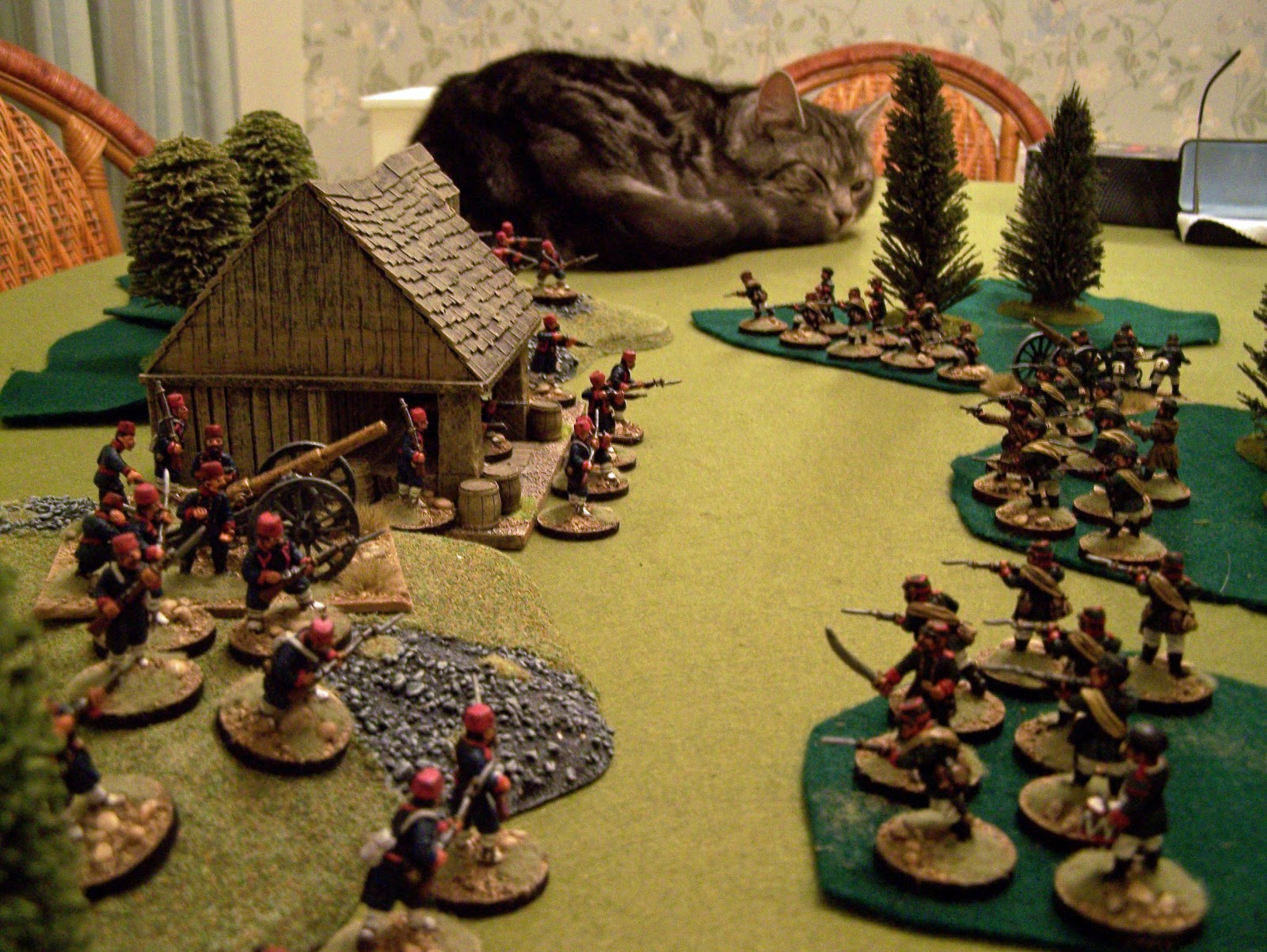
The Last War You Can Fight With Toy Soldiers

In 1877 the Russian Empire attacked the Ottoman Empire, ostensibly to save Christians in the Balkans from massacre, but in reality to extend her own empire and gain a Mediterranean port. 

This was the start of a remarkable, but now largely forgotten war. it saw the first use of the Red Crescent organisation and drew the borders of the Balkans we still have today. It also occurred at an interesting time for the development of military weapons and tactics.

The armies of 1945 and 1995 looked superficially pretty much the same, and mostly used similar tactics. However between 1845 and 1895 the nature of warfare changed dramatically, and it was only the absence of a major European war that stopped people noticing.

Turkish Cavalry by Balkandave
In 1845 infantry were armed with a black powder musket that loaded at the front and which would be
lucky to hit a barn door a 200 yards. As a result shooting was really just the preliminary to the more important business of trying to stick a bayonet into someone. The rifles of 1895 by contrast were more than just glorified spears. Lethal at a mile, they could fire ten rounds a minute. Almost as importantly they now fired smokeless ammunition, so it was very hard to even tell who was shooting at you. Barbed wire, portable machine guns and quick-firing artillery were also coming in, meaning that by the end of the century all the ingredients of the trench warfare of the First World War were in place.

Plevna by Balkandave
The increase in the lethality of firepower changed what armies looked like. In 1845 uniforms were designed to be seen. Helmets made the soldiers look taller, cross straps made them look beefier and bright colours allowed them to see who was a friend. By 1895 the more sensible armies were adopting uniforms that made the soldiers more difficult to be seen. They also no longer fought in the parade ground manner of Trooping the Colour, but spread out and using the terrain to hide. Soon men would start learning to live in holes in the ground. We were entering the world of Empty Battlefield, where the enemy were usually only seen when they were dead or prisoners.

At the same time industrialisation was increasing the size of armies exponentially. In 1845 you could probably watch the whole of a battle from a conveniently sited hill. By 1870, when armies of over 100,000 on each side fought on battlefronts seven miles long, you'd need a small mountain. By 1895 the Great Powers of mainland Europe were each capable of putting over a million men into uniform. Even a Zeppelin wouldn't let you see the whole battlefield.

A skirmish in the Shipka Pass by Balkandave
1878 though was the mid-point of this revolution. Rifles now loaded at the back, and could kill at half a mile, but they fired slowly and inaccurately. A determined enough charge could still get through, as the British Army was about to find out in Zululand and the Sudan, so troops still stood shoulder to shoulder. They also still fired black powder, so there was no hiding, and - with a few exceptions - still went into battle in their Sunday best.

If stood on the proverbial hill you could still, therefore, see lines of brightly coloured soldiers fighting each other in neat little lines. And is this not wargamers like to do with their toy soldiers? In 1878 it is possible to set out your armies on the tabletop in a way that resembled what the real generals would have seen.

This makes the Great War of 1878 the last war that can be realistically fought with toy soldiers.